

The core conclusion is that the key lies not in increasing the number of airport waiting sofas, but in reconfiguring spatial efficiency through dynamic zoning, intelligent scheduling, and behavioral guidance. The following five strategies can be directly implemented.
First, adopt modular sofa configurations to adapt to peak-hour fluctuations. Traditional airport seating arrangements are fixed, frequently leading to single passengers or luggage occupying multiple seats. Switching to modular seating allows for quick reconfiguration into single, double, or family-sized arrangements. During peak periods, units can be separated into individual seats, increasing utilization by over 30%. Relevant keywords include "modular airport seating" and "flexible sofa layouts in waiting areas."
Second, introduce intelligent occupancy monitoring to free up "hidden" empty seats. Embed pressure sensors beneath the sofa cushions and link them to a mini-program that displays a real-time heat map of available seats. Travelers can check seat availability instantly, eliminating the need to wander aimlessly in search of a spot. Additionally, if no weight is detected for 15 minutes, the system identifies the seat as occupied by luggage and triggers a voice reminder. Relevant keywords include "airport seat occupancy monitoring" and "waiting area seat availability check."
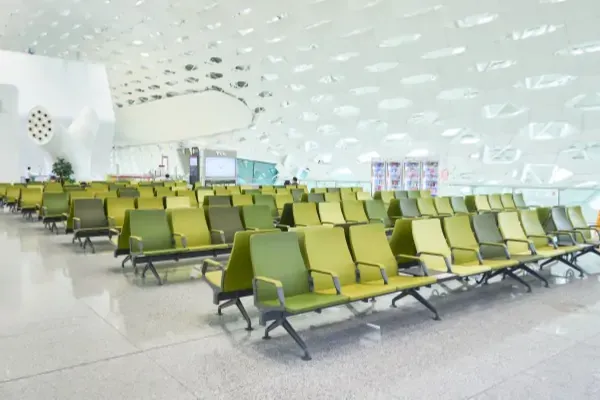
Third, integrate charging and storage functions into armrests to discourage passengers from occupying multiple seats. Installing wireless chargers and cup holders on armrests eliminates the need for travelers to place backpacks on adjacent seats. Field tests show this reduces the rate of luggage-occupied seats by 42%. Relevant keywords include "airport seating with charging" and "waiting area sofa armrest design."
Fourth, implement dynamic zoning by creating "quiet zones" and "quick-stay zones." Divide the seating area into quiet zones for longer stays—featuring window views and soft seating—and quick-stay zones near boarding gates, featuring firmer seats and small tables. Quick-stay zones enforce a 30-minute time limit, with reminders issued if the limit is exceeded. Relevant keywords include "quiet zone airport seating" and "time-limited quick-stay seating."
Fifth, utilize data-driven scheduling to adjust seating based on flight waves. Integrate flight departure data to shift seating arrangements toward the relevant boarding gates two hours prior to departure. For instance, during peak periods for international flights, waiting sofas can be relocated to the core area beyond the security checkpoint. Relevant concepts include the dynamic scheduling of airport seating and wave-based management of seating in the waiting area.
In summary, increasing the utilization rate of waiting sofas in airport lounges essentially means ensuring the seating moves to where the passengers are. By employing three strategies—modularity, intelligent monitoring, and behavioral design—it is possible to double seating turnover within a limited footprint; this approach offers valuable insights for airport operators and furniture suppliers alike.