

A sense of sophistication in an airport environment is not achieved simply by piling up "expensive" airport chairs. Rather, it emerges from the synergy of three elements: the systematic control of color, the deliberate selection of materials, and the spatial order of the layout. While travelers may not be able to articulate the design terminology, their bodies instinctively register the quality the moment they step into the waiting area.
1. Color: Low saturation sets the foundation, while nuanced layering creates sophistication.
Airport seating often employs low-saturation tones—such as muted blues, grays, taupes, or darker shades—which help alleviate pre-flight anxiety while remaining visually unobtrusive and resistant to showing dirt. The key to a premium feel lies in avoiding a flat, monochromatic look. For instance, the seating areas at Amsterdam Airport Schiphol eschew primary colors in favor of various European wood tones, unified by neutral terrazzo flooring; this creates a calm, cohesive atmosphere within a high-traffic terminal. From an engineering perspective, such custom colors must undergo rigorous testing for colorfastness, lightfastness, and batch consistency—otherwise, any variation across a large installation would immediately diminish the perceived quality of the space.
2. Materials: Sophistication is found in the "tactile refinement" one can actually feel.
Frames are typically constructed from high-strength aluminum alloy or cold-rolled steel tubing, finished with anodizing or electrostatic powder coating to ensure structural integrity while providing a matte or brushed texture. Regarding upholstery, flame retardancy is a baseline requirement; high-end airport seating distinguishes itself by balancing fire safety, durability, and tactile comfort. A premium alloy frame paired with high-grade, flame-retardant fabric can offer a design lifespan of 10 to 15 years, with shorter downtimes for maintenance. When selecting materials, the tactile quality shapes a traveler’s perception of the space’s "warmth," while weather resistance and ease of cleaning determine how the furniture will hold up after years of use.
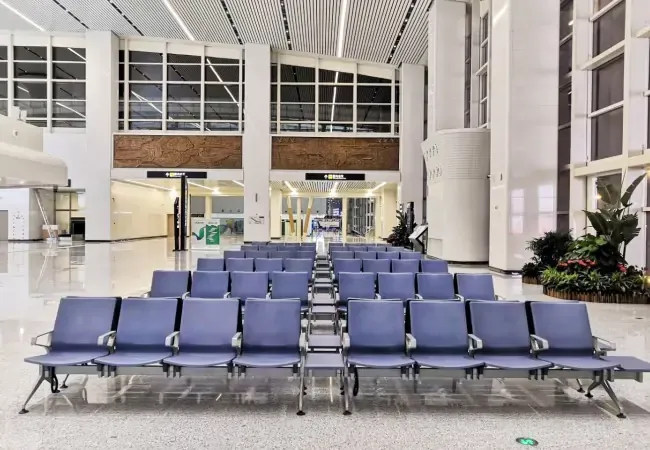
3. Layout: "Defining the space" through seating, rather than merely "arranging chairs."
Traditional, linear rows of seating often feel cheap because they address only the basic need for a place to sit, failing to account for the nuances of personal space and the distance between individuals. Sophisticated airport seating layouts organize chairs into spatial units of varying scales: angled, staggered positioning reduces the pressure of direct eye contact; a zigzag arrangement breaks the monotony of straight lines; and individual leg supports for each seat visually delineate personal boundaries. The implementation at Yinchuan Airport provides practical, actionable spacing parameters—a lateral distance of 1.1 to 1.4 meters between seats, with a 1.2-meter buffer from glass partitions, complemented by greenery to create a semi-private atmosphere. Modular seating systems further enhance layout flexibility, allowing for adjustments based on passenger flow; individual components—such as seats, armrests, and tabletops—can be replaced separately, preventing the need to discard an entire row due to localized damage.
For commercial and institutional clients, the evaluation of airport seating centers on three key factors: customization capabilities and color consistency; the total life-cycle cost of materials; and the degree of modularity combined with installation tolerance. Ultimately, a "premium" feel in airport seating design is the result of aligning aesthetic judgment with precise engineering parameters within a single design blueprint.