

For any business, procuring office chairs might seem like the simplest of tasks: compare prices, check styles, pick the cheapest option, and place a bulk order. However, if your procurement mindset remains fixated solely on the "unit price," your company may actually be paying a steep "hidden cost" for that very decision.
An unsuitable chair not only leads to back pain and reduced productivity among employees but can even negatively impact your employer brand image during the recruitment process. Trends in the 2026 office environment clearly indicate that office furniture procurement is no longer merely the "purchase of assets," but rather a long-term investment in both employee health and corporate productivity. So, beyond the price tag, what exactly should we be looking for?
I. Focusing Solely on "Low Prices" Means Employees Pay the Price—With Their Backs
Many procurement officers opt for standard office chairs in the 300–500 RMB price range, believing these are perfectly adequate for basic office needs. The reality, however, is that these standard chairs offer only basic height adjustment; their foam cushions often collapse within six months, providing absolutely no lumbar support.
This represents the biggest misconception in office procurement. In the 2026 office chair market, "dynamic support" has become a standard feature. Ergonomic chairs—such as the Heibaodiao P2 Pro, which falls within the sub-1000 RMB range—now come equipped with large 4D lumbar supports. These supports feature adaptive front-to-back tracking, automatically adjusting their contact points to follow changes in the user's sitting posture. If your procurement list still includes "hard benches" with fixed lumbar supports, the fatigue generated by prolonged sitting will ultimately translate into diminished output and increased medical costs.
Procurement Tip: For employees whose roles require sitting for more than 8 hours a day on average, investing just an additional 200 RMB to select an ergonomic chair—one featuring basic split-back support or dynamic lumbar support—can improve the fit and alignment with the user's lumbar spine by over 37%.
II. "Chairs" or "Medical Bills"? Health Is the Greatest Hidden Cost
"65% of employees rate the comfort level of their workstations as 'unsatisfactory,' with the most frequent complaint being that the desk and chair heights are not ergonomically aligned."
We recommend shifting your procurement focus away from "price" and toward "support." To identify a truly excellent chair, you must examine three key components: the lumbar support, the armrests, and the seat cushion.
·Lumbar Support: The "Fit Factor—Stop buying those chairs with rigid lumbar pads that merely press against a single point on your lower back. A genuine lumbar support system should offer adjustable depth (forward and backward). Superior designs provide comprehensive support spanning the entire region from the lumbar vertebrae down to the sacrum. Furthermore, when employees lean forward to work, their lower backs should not be left unsupported; the lumbar support mechanism must be capable of shifting forward in tandem with their movement.
·Armrests: The "Support Strength—Leaving your arms suspended in mid-air while typing is the primary culprit behind shoulder and neck strain. When making a purchase, prioritize armrests that offer multi-dimensional adjustability (such as 4D armrests), allowing your elbows to rest naturally and remain fully supported.
·Seat Cushion: The Breathability Factor—While high-density foam offers excellent support, it tends to trap heat and become stifling during prolonged sitting. The prevailing trend for 2026 favors high-resilience, breathable mesh fabrics; these materials not only effectively distribute pressure across the thighs but also spare you the embarrassment of a sweaty back during the summer months.
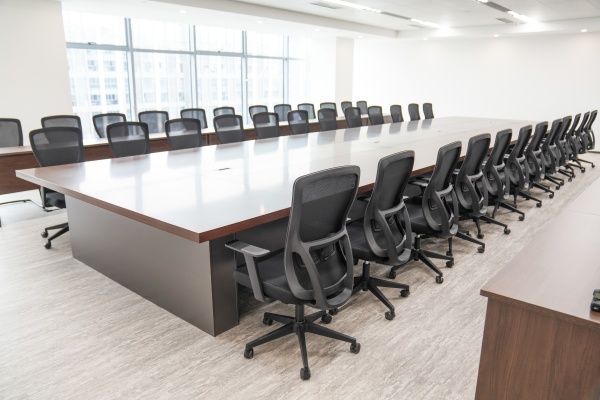
III. Materials and Safety: Hidden Dangers Lurk in Unseen Places
When budgets are tight, suppliers may be tempted to cut corners on critical components such as the gas lift cylinder and the chair base. This is not merely a matter of durability; it constitutes a serious safety hazard.
The Safety Baseline for 2026 Procurement:
Certification Marks: It is imperative to verify that the chair has obtained certifications from both BIFMA (the U.S. standard for office furniture) and SGS. By 2026, dual certification is expected to be a standard feature in 78% of mainstream brands; specifically, the gas lift cylinder must meet the Class 4 explosion-proof safety rating.
Material Differentiation:
Staff Chairs: We recommend selecting a combination of a nylon base and breathable mesh fabric—a lightweight solution that offers moderate cost-effectiveness.
Executive/Managerial Chairs: If you prioritize a premium aesthetic and tactile quality, you must distinguish between top-grain cowhide and microfiber leather. Genuine leather offers superior breathability and durability but requires regular maintenance, whereas microfiber leather provides excellent value for money, albeit with a slightly less luxurious feel. For the chair frame, we recommend opting for solid wood or reinforced cold-rolled steel to ensure long-term stability and prevent wobbling.
IV. Usability: Even the Best Features Are Useless If They Aren't Used
"No matter how sophisticated a feature is, if the operation is overly complicated, it simply won't get used."
Many high-end chairs are purchased with an array of advanced functions, yet employees often neglect to utilize them because they find the array of complex knobs and levers too cumbersome to adjust. Savvy procurement professionals should prioritize "intuitive adjustability."
One-Touch Operation: The chair's control system should be streamlined, allowing employees to effortlessly adjust the height and recline tension while remaining seated.
Midday Rest Functionality: In the 2026 workplace, taking a midday break has become a fundamental necessity. When making purchasing decisions, it is advisable to look for chairs with backrests that recline beyond 135 degrees—or even feature a retractable footrest. This capability effectively enhances employees' productivity and focus during the afternoon.