

In airport terminals with tens of thousands of passengers daily, waiting chairs are the facility where passengers spend the most time. A good waiting chair must not only be comfortable for passengers but also withstand the high-intensity use, frequent cleaning, and the demands of various body types and weights throughout the year. So, how can airport waiting chairs achieve both comfort and durability? The answer lies in the details of materials science, ergonomics, and structural engineering.
1. Materials: A Balance Between Feel and Resistance to Damage.
The seat cushions and backrests of airport public seating directly determine comfort and durability. High-density foam (≥45kg/m³) combined with PU leather or genuine leather upholstery provides a sofa-like feel, while the surface must be wear-resistant, scratch-resistant, and stain-resistant. All-metal mesh waiting chairs use high-strength aluminum alloy or spray-coated steel plates, are breathable and not stuffy, completely eliminating scratches and cigarette burns, making them suitable for short-haul waiting areas.
2. Ergonomics: Support for Comfortable Long Periods.
Scientific ergonomic design enhances comfort and reduces excessive wear in certain areas. The backrest curvature should conform to the physiological curvature of the lumbar spine, providing significant lumbar support. Standard seat depth is 450-500mm and seat height is 430-450mm, suitable for most adults. Armrest height is 180-220mm, and seat center distance is ≥580mm, ensuring no interference between adjacent passengers and reducing the probability of armrest collision damage.
3. Structural Engineering: Invisible Lifespan Guarantee.
A durable terminal chair withstands thousands of sitting pressures, luggage impacts, and cleaning agent corrosion daily. The load-bearing frame is recommended to be made of cold-rolled steel plate of 2.0mm or thicker or 6063 aluminum alloy, electrostatically sprayed (thickness ≥80μm) and passed a salt spray test for over 200 hours. The seat and crossbeam are secured with concealed bolts to prevent exposed screws from scratching passengers. The bottom features anti-slip pads, the chair's unloaded tilting force is ≥1500N, and it can be fixed to the ground. Ideally, the seat cushion should be quick-removable (tool-free or single-key operation) for easy cleaning and replacement of damaged parts.
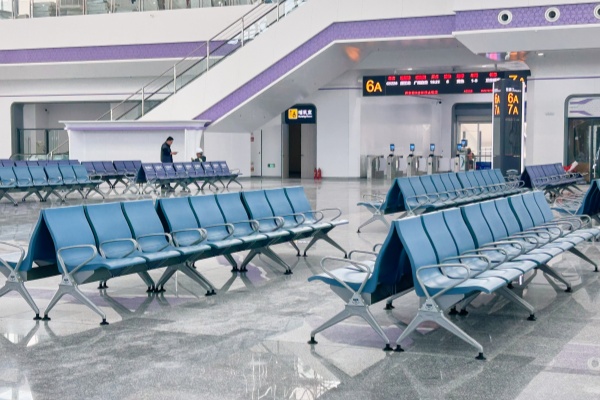
4. Additional Features: Thoughtful Design Without Sacrificing Durability
Modern airport smart waiting chairs often integrate charging ports, cup holders, or small tables. Armrests have built-in USB ports and five-hole sockets, requiring waterproof and dustproof properties (IP54 or higher). Cables are concealed in cable management channels in the chair legs to prevent damage from kicking or pulling. Cup holders are recommended to be made of PP or nylon through one-piece injection molding, with a load-bearing capacity of ≥3kg. Folding tables feature damped soft-close, and the hinges are made of stainless steel, having undergone 50,000 opening and closing tests. These features enhance the experience while also ensuring sufficient durability.
5. Cleanliness and Hygiene: A Necessity in the Post-Pandemic Era
Frequent disinfection puts a strain on seat surfaces and crevices. Easy-to-clean waiting chairs should minimize grooves and seams, and use large rounded corners. Adding silver ion antibacterial agents to the paint or plastic can inhibit bacterial growth. Leather materials should be resistant to alcohol and hypochlorous acid wiping without discoloration or cracking.
6. Conclusion Airport waiting chairs achieve both comfort and durability not through a single cutting-edge technology, but through a systematic design approach: high-quality materials as a foundation, ergonomics to enhance the experience, robust structure to ensure lifespan, and additional functions as icing on the cake. For airport operators, choosing suppliers that have passed EN 16139 or BIFMA X5.1 durability tests, and referring to real-world case reports with over 5 years of usage, will help avoid high maintenance costs later on.