

Durability in airport sofa isn’t just about "extra thickness"; it requires engineering redundancy across four key dimensions: upholstery, frame, padding, and quality standards. In a terminal, furniture faces constant impacts from luggage wheels, daily disinfection (dozens of times over), and continuous weight-bearing for hours on end. Standard commercial-grade sofas often show signs of wear—such as pilled fabric, sagging cushions, or loose welds—within just two to three years. When selecting airport seating, focus on the following quantifiable metrics:
1. Upholstery: Abrasion resistance is the baseline, but resistance to disinfectants is the real test.
For airport seating, thickness alone is not enough. Commercial-grade upholstery should ideally withstand at least 30,000 cycles on the Martindale abrasion test; for high-traffic areas, this should exceed 150,000 cycles. Even more critical is resistance to chemical degradation: frequent cleaning with chlorine-based disinfectants or quaternary ammonium compounds can cause untreated materials to become brittle and crack. Opt for commercial-grade PU, vinyl, or high-durability performance fabrics that are stain-resistant, flame-retardant, and easy to wipe clean.
2. Frame: Steel wall thickness and surface treatment determine the lifespan.
Airport seating must endure high-frequency stress from the impact of people sitting down and collisions with luggage. Metal bases and crossbeams should be constructed from cold-rolled or powder-coated steel tubing with a wall thickness of 1.2–2.0 mm, with welds ground smooth and treated against rust. For terminals in coastal or high-humidity regions, 304-grade stainless steel should be considered. Electrostatic powder coating generally offers better salt-spray resistance than standard baked-on paint; for seating located near entrances, look for components that have passed a salt-spray test of 500 hours or more.
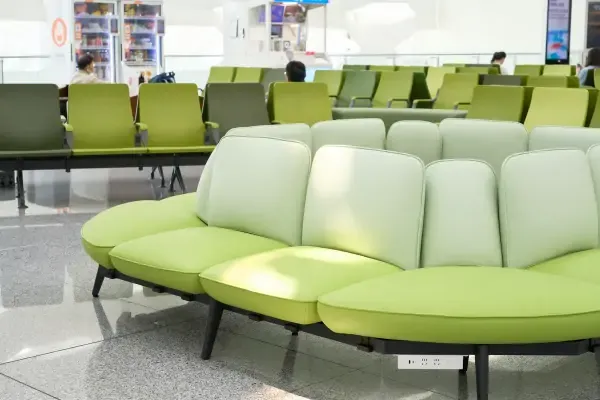
3. Padding: Foam with a density below 40 kg/m³ will inevitably sag under high-frequency use.
Because airport seats are occupied repeatedly by travelers of varying weights, low-density foam will lose its resilience in just a few months. The padding should consist of high-density, molded polyurethane (PU) foam with a density of at least 40 kg/m³ and a resilience factor of 60% or higher. For the seat base, 12mm (or thicker) multi-layer plywood is recommended; it creates a rigid support structure when paired with a metal frame, preventing the edges of the seat from sagging or softening prematurely.
4. Inspection: Rely on test reports, not promotional brochures.
When procuring public seating for airports, explicitly request that suppliers provide test reports covering durability, flame retardancy, and hazardous substance content. Additionally, verify that the fabric’s abrasion resistance, the frame’s wall thickness, and the foam density match those of the approved sample. In high-traffic environments, these four specifications are essential to ensuring that terminal seating is truly built to withstand intensive, frequent use.