

In the field of airport furniture procurement, whether airport waiting sofas are consumables or long-term assets is a frequently discussed question among airport operators, design institutes, and project contractors. Especially in high-traffic terminal environments, the lifespan of airport waiting area sofas directly impacts operating costs, passenger experience, and the overall image of the airport.
1. Why are airport waiting sofas often mistakenly considered "consumables"?
For airports that handle thousands of passengers every day, the rapid wear and tear of airport waiting sofas seems to be an "industry consensus":
• Extremely high traffic: The high density of passengers in waiting areas, boarding gates, and international transfer areas means sofas are used far more frequently than in shopping malls or offices.
• Severe external wear and tear: Luggage bumps, metal luggage handles scratching, and children jumping on the sofas cause continuous damage to public area sofas in airports.
• High cleaning frequency: Airports have strict cleaning requirements, and frequent disinfection can accelerate fabric aging.
• Unsupervised environment: 24-hour operation means maintenance personnel cannot constantly check the structure or fabric condition of the sofas.
These factors lead many airports to treat airport waiting sofas as "high-consumption items," opting for low-cost replacements.
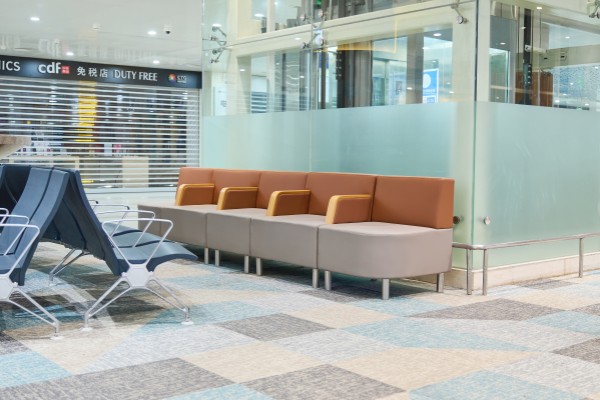
2. Truly excellent airport waiting sofas are "long-term assets," not "consumables"
For mature airport management teams, airport waiting sofas are considered fixed assets (Long-Term Facility Assets), not quickly consumable furniture. The criteria for this judgment include:
a. A service life of 8–12 years or more
High-quality airport terminal waiting sofas use thickened stainless steel structures, high-resilience molded foam, and wear-resistant leather or fire-retardant fabrics to meet the following requirements:
Compression resistance
Deformation resistance
Flame retardancy
Structural stability
Long-lasting support
If procured properly, an airport waiting sofa should have a stable service life of more than 8 years, not requiring replacement every 2-3 years. b. Modular structure significantly reduces maintenance costs
Modern airport public waiting sofas feature:
Replaceable backrest modules
Individually replaceable seat cushions
Detachable metal legs
Independent power module design (for airport sofas with charging function)
No need to replace the entire sofa; only partial replacement is required.
c. Maintenance costs are significantly lower than replacement costs
In airport annual budgets, maintenance costs for minor damage are often low, but the cost of replacing the entire set is extremely high.
Treating airport waiting sofas as long-term assets ensures:
Planned maintenance
Consistent aesthetic style
Lower total cost of ownership (TCO)
3. How can airport waiting sofas reduce life cycle costs by 30%?
• Use highly durable materials (≥100,000 Martindale): Suitable for high-traffic airport waiting sofas.
• Choose fabrics and sponges with flame-retardant certification: Reduces safety risks and subsequent modification costs.
• The structure must be commercial-grade and engineered for reinforcement: Armrests, legs, and sofa frames must meet airport-grade strength requirements.
• Choose airport sofa series with modular maintenance capabilities: Replacing a single cushion costs 80% less than replacing the entire set.
• Choose a design that is easy to clean: Stain-resistant and scratch-resistant leather significantly reduces cleaning labor costs.