

Waiting for a flight is often the most overlooked part of a journey, yet it frequently consumes the most time. The comfort of a airport seat directly impacts a traveler's mood, physical recovery, and even their state of mind for the journey ahead. High-quality airport seating is redefining the waiting experience across four key dimensions: ergonomics, spatial layout, functional integration, and durability.
1. Ergonomics: Turning Waiting into a Stress-Free Experience
Before long-haul flights, travelers often spend considerable time walking while carrying luggage. Traditional flat-bench seats lack lumbar support, often causing spinal strain. High-quality airport seats typically feature contoured backrests and high-density foam cushions; backrest angles are optimized between 100° and 110°, while seat depth is carefully calibrated to distribute weight evenly across the thighs. Some models utilize an "embracing" curved backrest design to provide lumbar support, allowing travelers to truly relax while they wait. This ergonomic focus shares the same design philosophy as auditorium and theater seating—whether in an airport or a conference center, the core objective is to ensure that prolonged sitting does not become a physical burden.
2. Spatial Layout: From "Rows of Seats" to "Waiting with Dignity"
For decades, public seating in airports consisted mostly of fixed, linear rows. Today, modular designs offer greater flexibility—concave, convex, and straight elements can be combined to suit the specific spatial constraints of different waiting areas. Some modern airport seats feature angled or zigzag arrangements where seats are slightly offset, preventing direct face-to-face contact and creating a more private atmosphere. This shift—moving from merely "having a place to sit" to "sitting comfortably and with dignity"—is becoming a global standard in airport design.
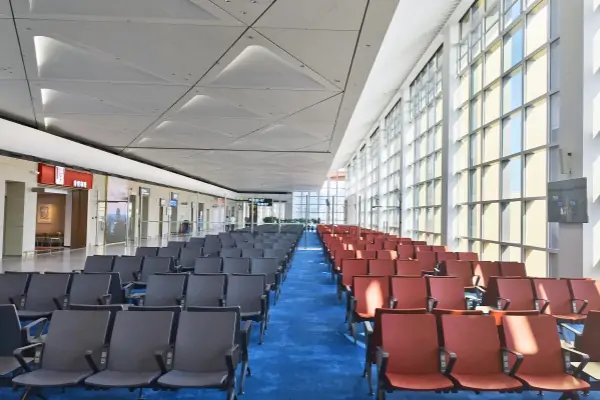
3. Functional Integration: More Than Just a Place to Wait
Modern travelers require more than just a chair in the waiting area. High-quality public seating is increasingly integrating practical features: USB and Type-C charging ports have become standard; some models include flip-up side tables for snacks or laptops; and under-seat storage spaces ensure that carry-on luggage does not take up valuable seating room. When seating simultaneously meets diverse needs—such as resting, device charging, and working—waiting for a flight shifts from merely "killing time" to "making productive use of time."
4. Durability and Ease of Maintenance: The Unseen Standard of Quality
Airport waiting areas experience heavy foot traffic, requiring seating that can withstand frequent use and repeated cleaning. High-quality airport seating typically features an aluminum alloy frame and a high-density, integrally molded PU (polyurethane) seat unit; a single seat usually supports a static load of at least 120 kg. The PU material offers thermal comfort (warm in winter, cool in summer), is fire- and water-resistant, and is easy to clean, while the aluminum alloy combines low density with high strength and corrosion resistance. These details directly determine the seating's lifespan and ensure a consistent experience for every traveler.
5. Conclusion
A high-quality airport chair serves as a silent guardian in the waiting area. It supports the body through ergonomic design, protects privacy via thoughtful layout, and fills the waiting time with convenient features—transforming every pre-flight wait into a memorable part of the journey.