

When sourcing public seating for airport terminals, choosing between custom airport sofas and standard models essentially involves balancing "spatial image" against "operational efficiency." The core recommendation is straightforward: opt for standard models in high-turnover areas like departure halls and remote boarding gates, while prioritizing custom airport sofas for VIP lounges and First/Business Class waiting areas. The following three points will help clarify your decision-making process.
I. Standard Airport Seating: Rugged Durability and High Turnover Efficiency
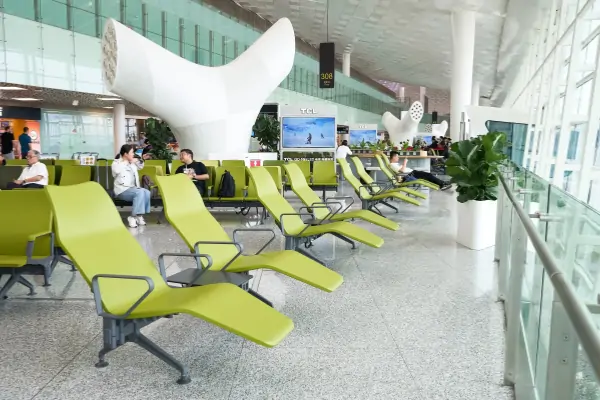
Standard airport tandem seating typically features aluminum alloy legs and polyurethane cushions; its key advantages lie in modular assembly and ease of cleaning and maintenance. In terminal waiting areas accommodating thousands of passengers daily, standard public seating offers time-tested features such as impact-resistant armrests, horizontal sliding mechanisms, and anti-pinch designs. With fixed ergonomic specifications for cushion thickness and seat spacing, procurement is streamlined—requiring only verification of antimicrobial coatings and load-bearing capacity—making them ideal for high-wear environments like arrival halls and high-speed rail transfer zones.
II. Custom Airport Seating: Exclusive Quality and Enhanced Brand Value
The value of customization becomes immediately apparent when the project involves VIP lounges or premium-class waiting areas. You can integrate wireless charging modules into armrests or add adjustable neck pillows to seatbacks. Upholstery options can be upgraded from basic PVC to top-grain leather or breathable, flame-retardant fabrics, and can even incorporate airline-specific color schemes and embroidered logos. Crucially, custom seating can perfectly fit irregular spaces—such as curved partitions or areas alongside scenic windows—transforming the seating area from a cold row of chairs into a welcoming space that reflects the brand's identity. Established public seating manufacturers (such as those in Foshan) typically offer prototyping services to ensure the seat's firmness and comfort precisely match the design specifications.
III. Cost and Lead Time: Short-Term Investment vs. Long-Term Value
Standard airport seating benefits from mature manufacturing molds, resulting in controllable per-seat costs and a typical production lead time of 25–30 days; furthermore, costs for future upholstery replacement and accessory repairs are transparent. Customizing terminal sofas involves costs for mold creation and material sampling; minimum orders are typically 50 units, with a lead time of 45–60 days. However, high-quality custom sofas offer a lifespan exceeding 10 years and a significantly lower failure rate compared to modular, assembly-style seating, effectively reducing the frequency of refurbishment required for public airport seating in the long run.
IV. Practical Advice: Assess the Setting Before Discussing Specifications
When procuring airport seating, it is advisable to segment requirements based on the specific area: purchase standard seating in bulk for general waiting areas to ensure efficient maintenance and operations, while opting for bespoke, high-end sofas in VIP areas to enhance the passenger experience. Regardless of the choice, ensure the manufacturer holds Civil Aviation Administration (CAAC) fire-retardant certification and salt spray test reports, and offers a five-year warranty on the frame. Simply provide a floor plan and estimated passenger volume, and a professional seating manufacturer can develop a tailored configuration plan to help you achieve an optimal waiting experience within a reasonable budget.